
Rules-based controls
Configure thresholds and severity for high-value journals, unusual posting hours, dormant account activity, repeated reversals, period-end adjustments, duplicate references and interbranch imbalances.
VXFRMS MODULE
Find unusual ledger activity, inspect the evidence and coordinate investigation in one workspace.
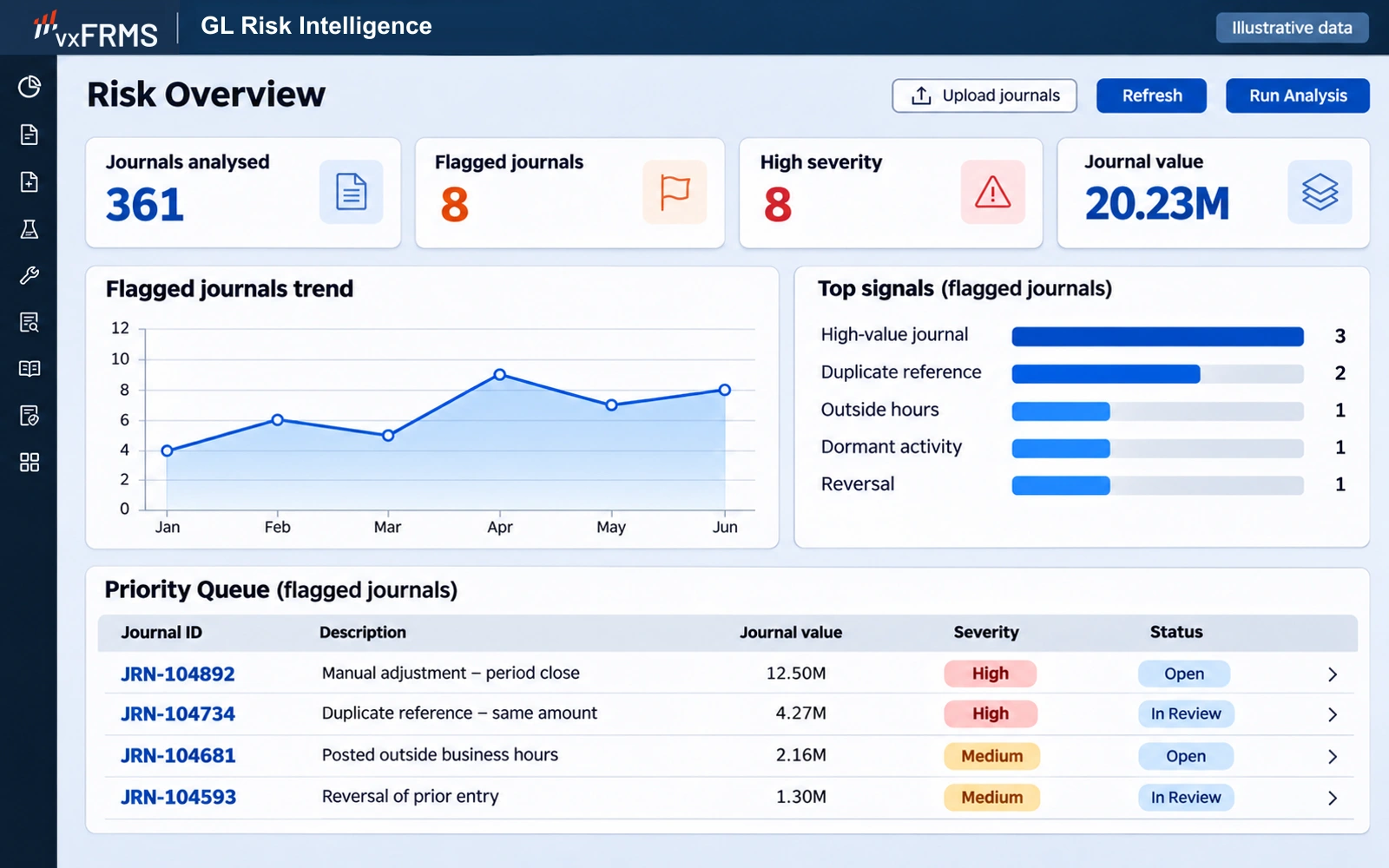
Monitor flagged journals, severity and the signals driving the review queue.
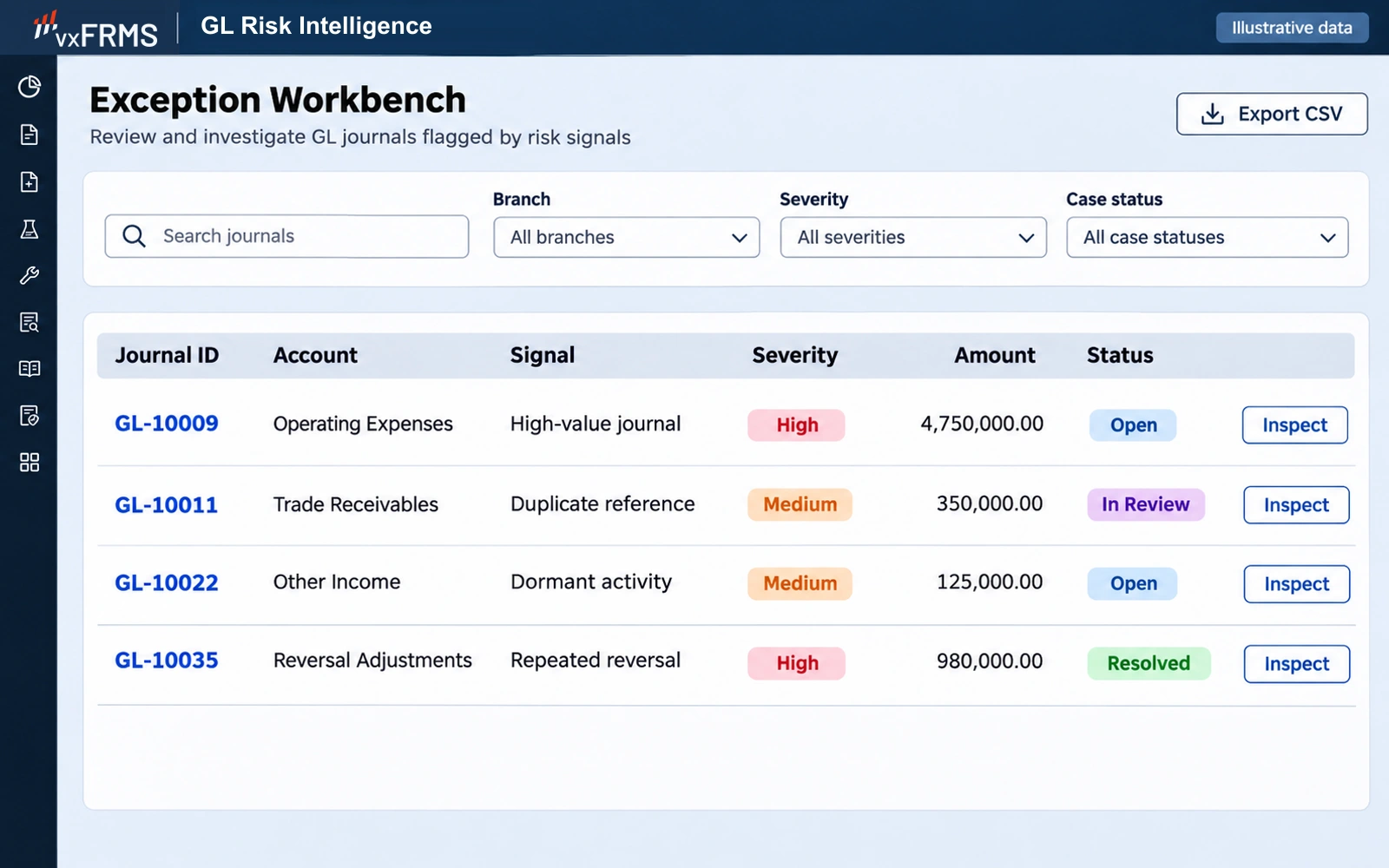
Filter by branch, severity and case status, then open the evidence.
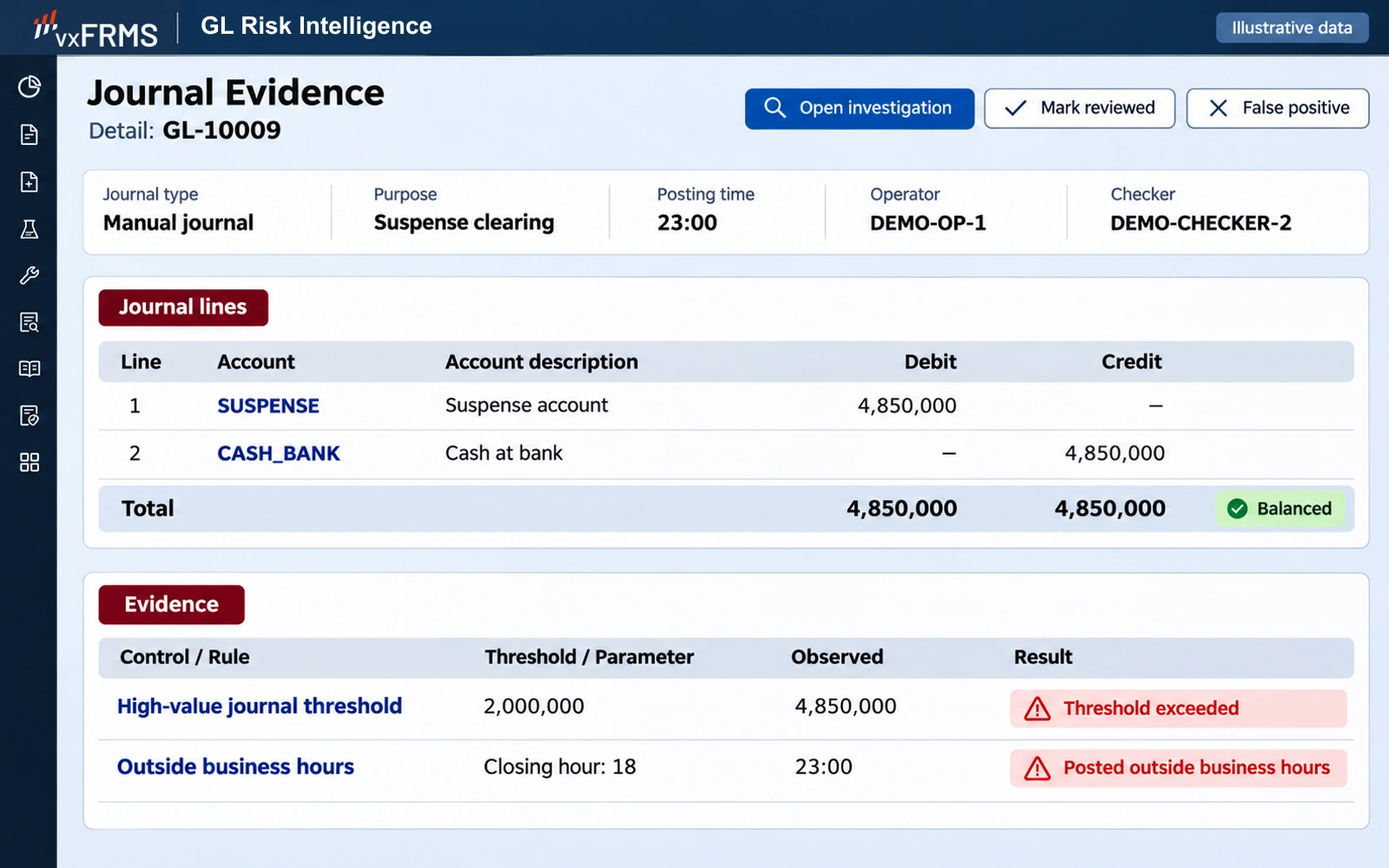
Inspect linked debit and credit lines alongside posting context and detection signals.
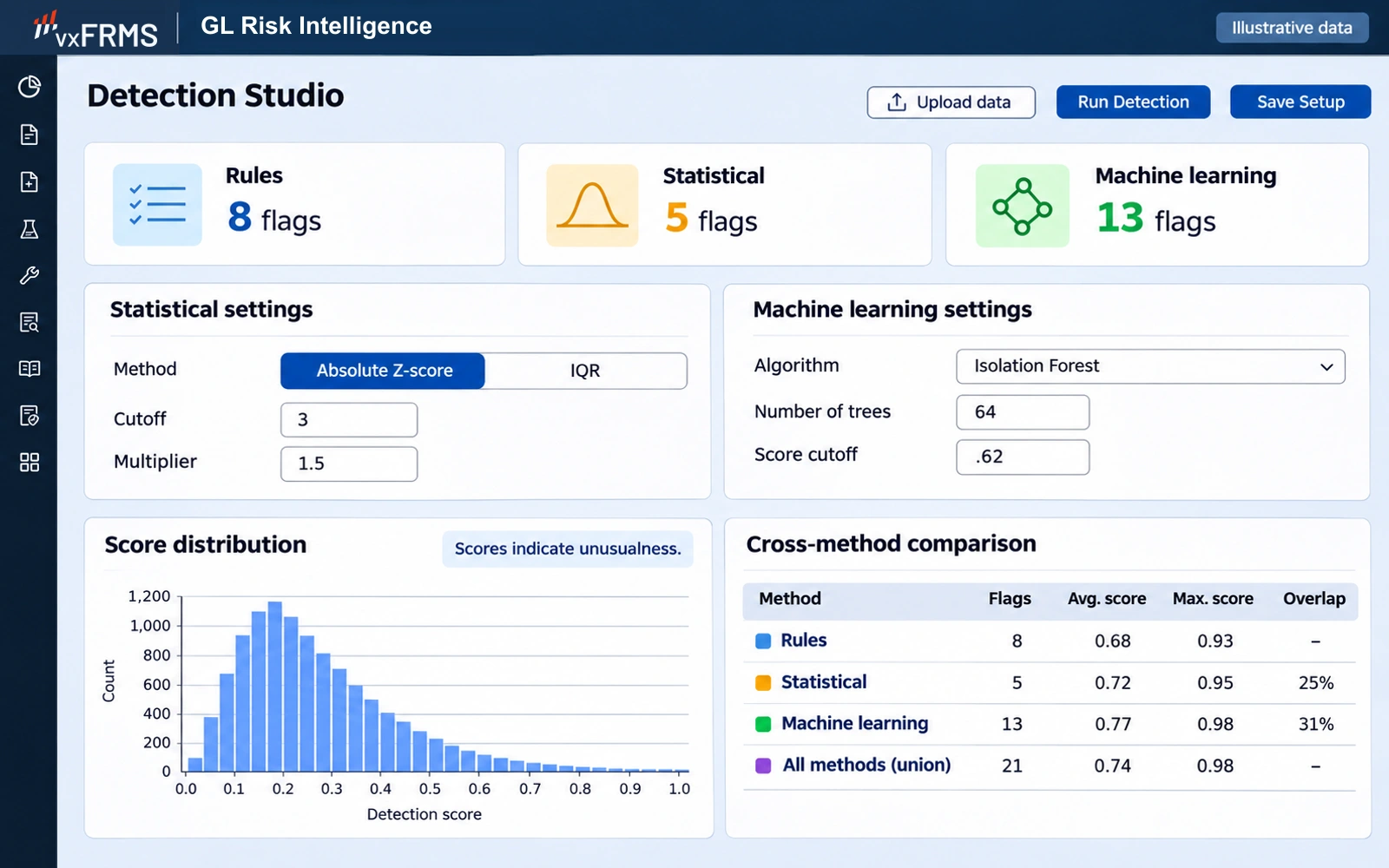
Compare rules, statistical deviations and machine-learning scores on the same journals.
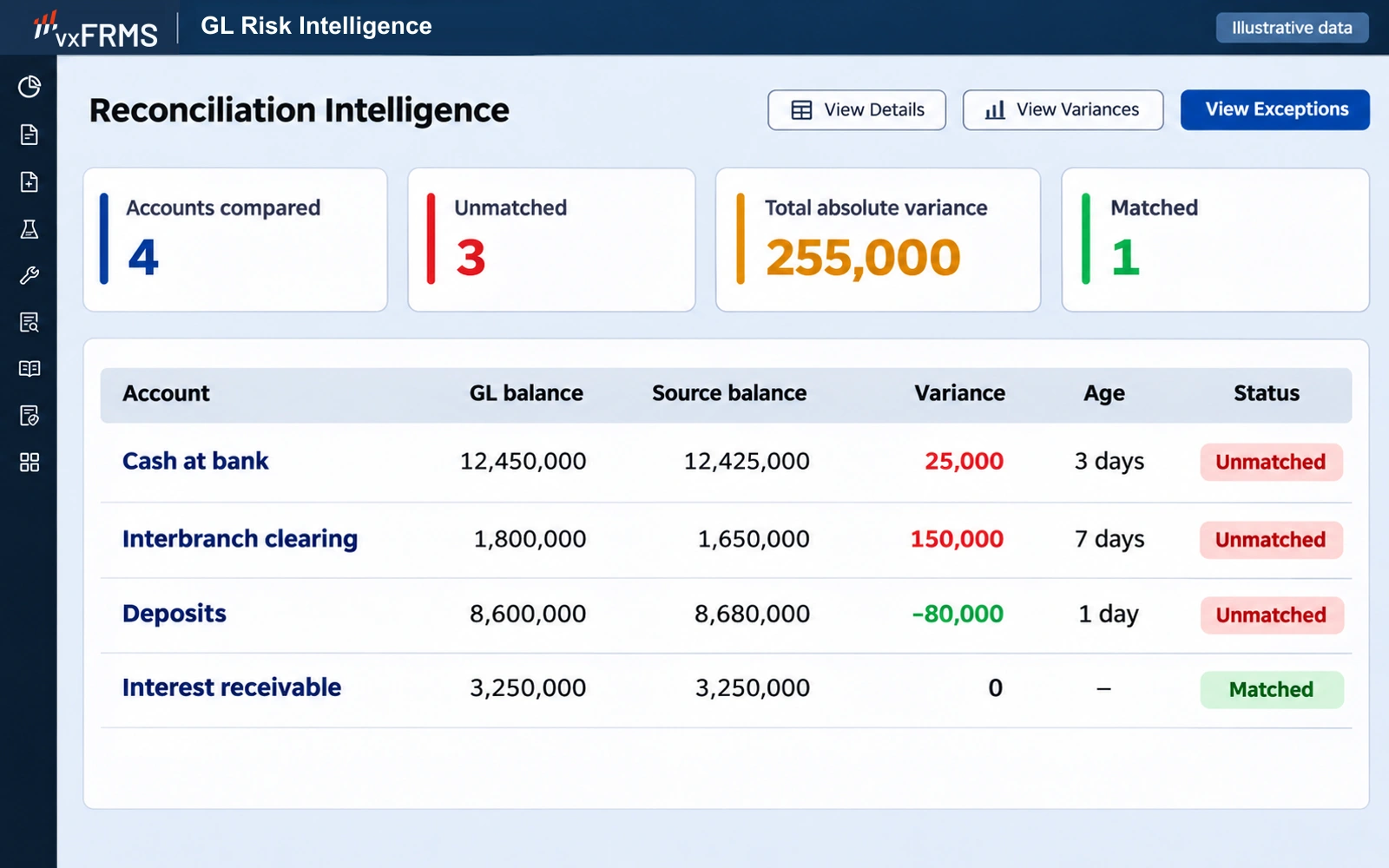
Compare ledger and source balances and investigate aged differences.
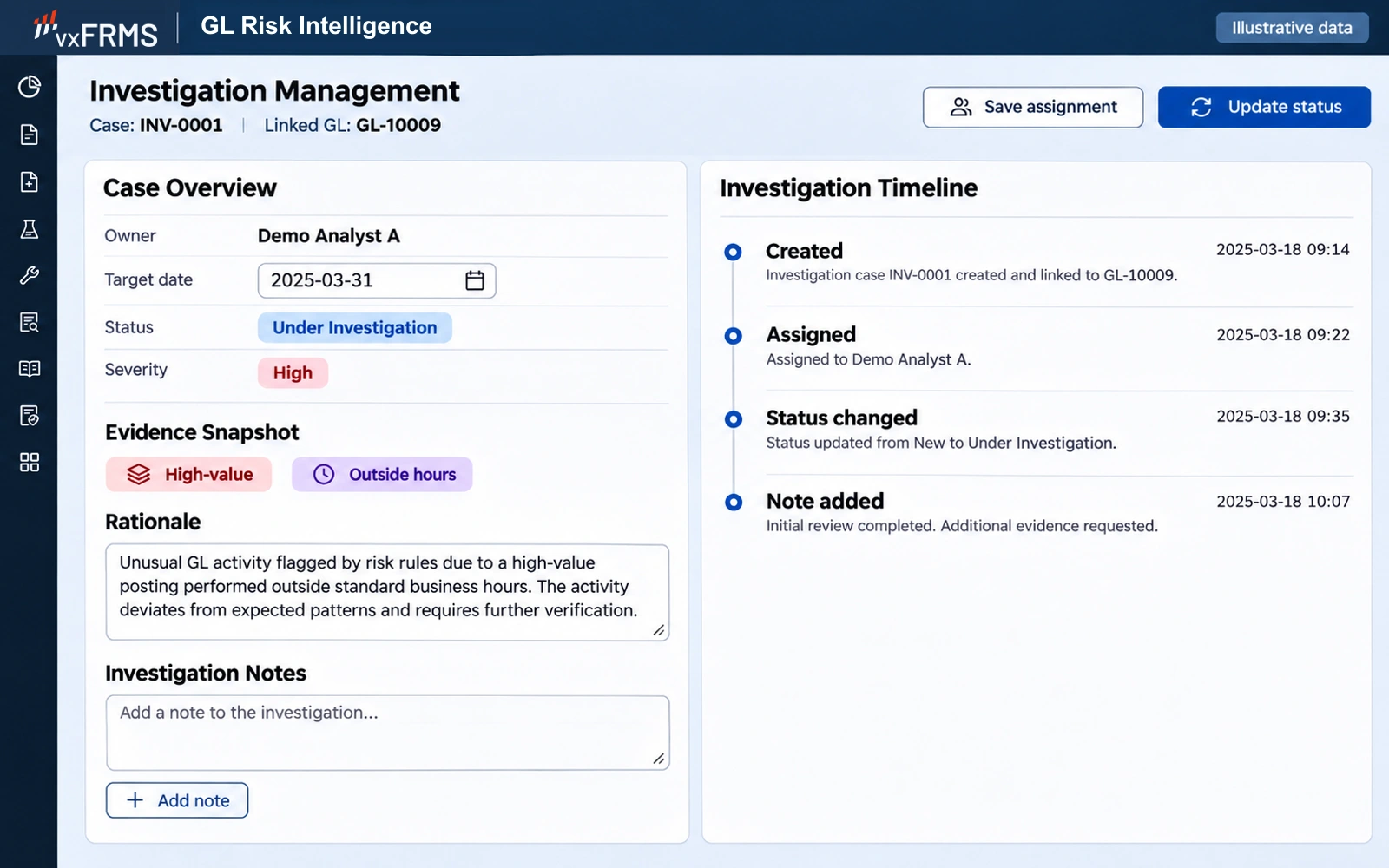
Assign owners, set target dates and document the case journey.
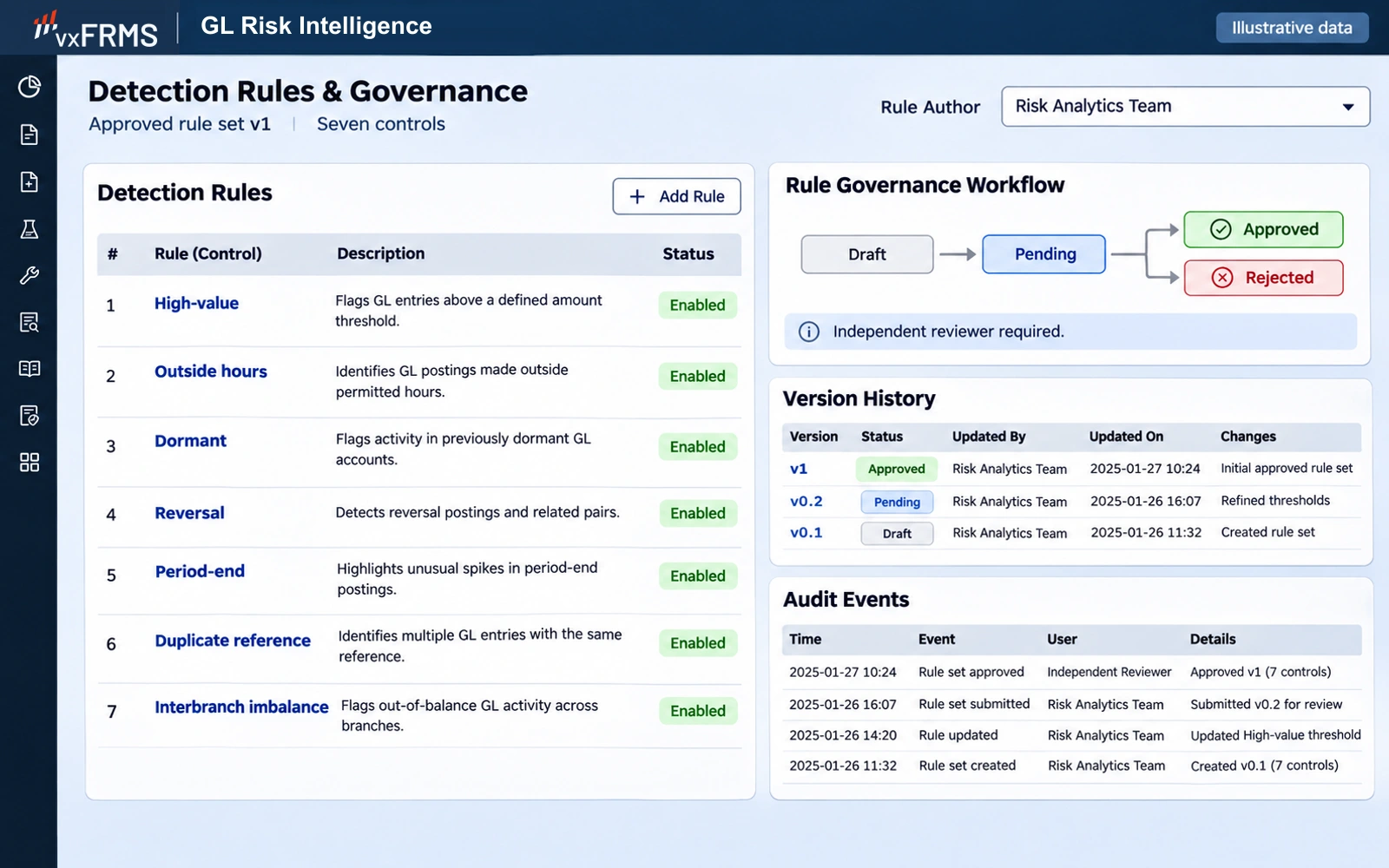
Prepare rule changes and submit them for independent review.
FROM SIGNAL TO INVESTIGATION
Apply controls and analytical models to journals.
Review journal lines, posting details and signal evidence.
Assign a case, document findings and track follow-up.
Configure thresholds and severity for high-value journals, unusual posting hours, dormant account activity, repeated reversals, period-end adjustments, duplicate references and interbranch imbalances.
Compare journal amounts with the historical baseline for each account. Select absolute Z-scores or interquartile range (IQR) and adjust the cutoff to explore how the set of flagged journals changes.
Use Isolation Forest to identify unusual combinations of amount, posting hour, inactivity, reversals, counterpart variance and manual posting. Review score distributions and compare signals across methods.
An anomaly score expresses unusualness. Findings need investigation to determine their cause and significance.
Review flagged journal counts, severity, journal values and trends. Search the exception list and filter by branch, severity or case status to prioritize review.
Inspect linked debit and credit lines, the source system and reference, posting time, operator and checker. Compare observed values with the rule threshold that produced each signal.
Compare general ledger and source balances side by side. Review the signed variance, exception age and supporting explanation, then open a linked investigation.
Assign an investigator and target date. Move cases through assignment, investigation, clarification, resolution and closure. Reopen a case when further evidence emerges.
Capture the finding at case creation, record notes and transition rationale, and follow the event timeline. Mark a journal reviewed or record false-positive feedback with its rationale.
Export exception lists, reconciliation results, the investigation register and rule-change audit events for further analysis and review.
Create or revise a rule and preview its effect on the ledger.
Submit the request for a different identity to approve or reject.
Approved rule changes become active, with version snapshots and event history.
Author, approver, auditor and administrator views demonstrate different permissions. Statistical and machine-learning tuning has a separate exploratory workflow in the demo.
All three detection approaches are available to demonstrate. Tailor the rules, historical baselines, account groupings and model inputs to your portfolio and requirements.
Agree source mappings, journal structure, reporting periods, reconciliation criteria and timing tolerances for the institution’s operating environment.
Choose accounting controls and calibrate statistical or machine-learning thresholds using suitable historical data and review findings with domain specialists.
Define case responsibilities, approval authorities, reporting needs and the integration and record-keeping requirements for production deployment.
The demonstration uses synthetic journals and source-balance snapshots. Role permissions, approvals, case workflows and event history are simulated in the browser. Statistical and machine-learning methods use a separate historical baseline. Production deployment requires agreed data integrations, access controls, persistent storage and validation against institution-specific requirements.