
Integrated EIR calculation
Calculate Effective Interest Rates (EIR) within the ECL system.
VXFRMS MODULE
Automate the impairment reporting cycle with configurable staging, forward-looking risk models and a traceable calculation engine.
Explore advisory services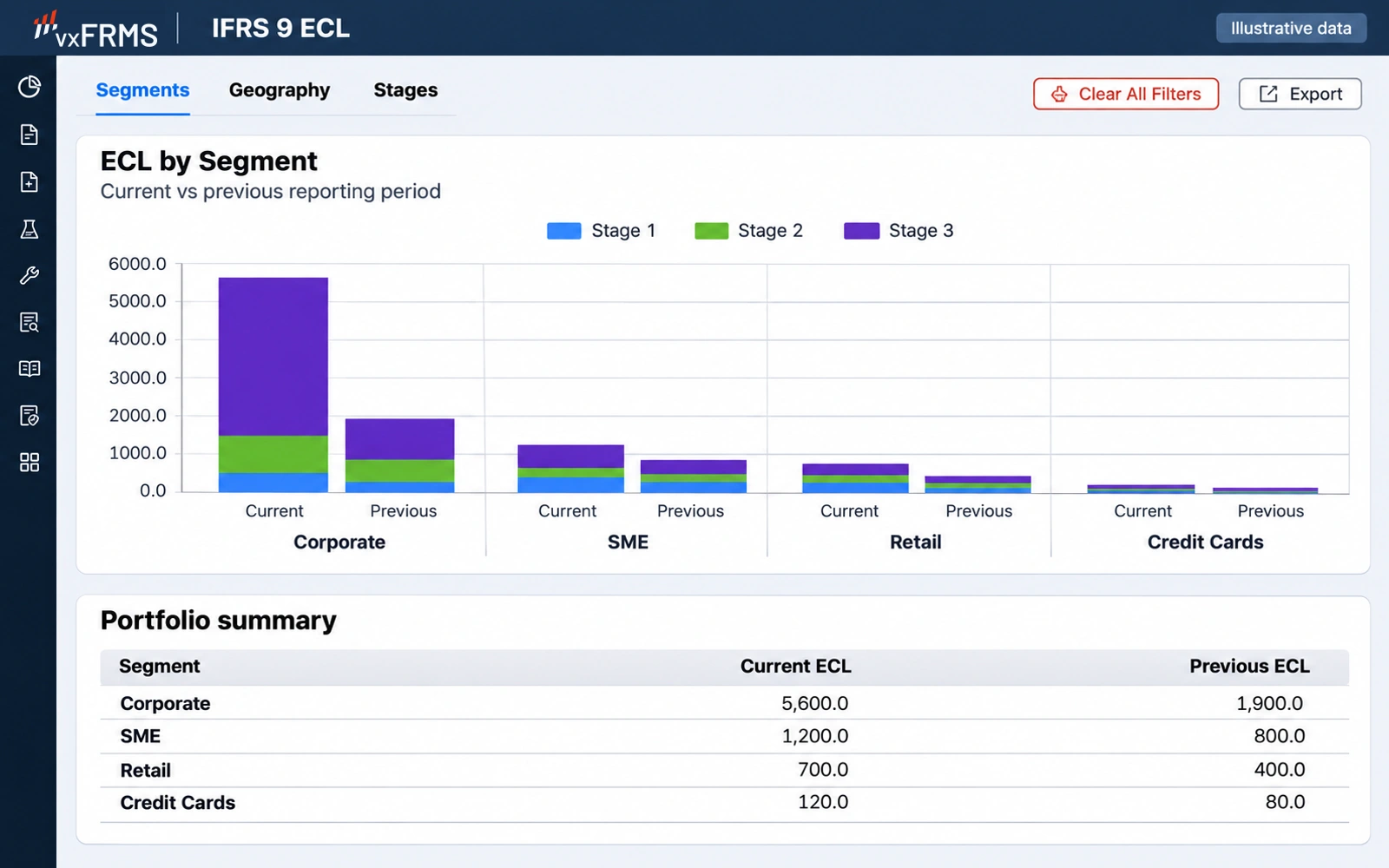
Compare expected credit loss by portfolio segment and impairment stage.
How it works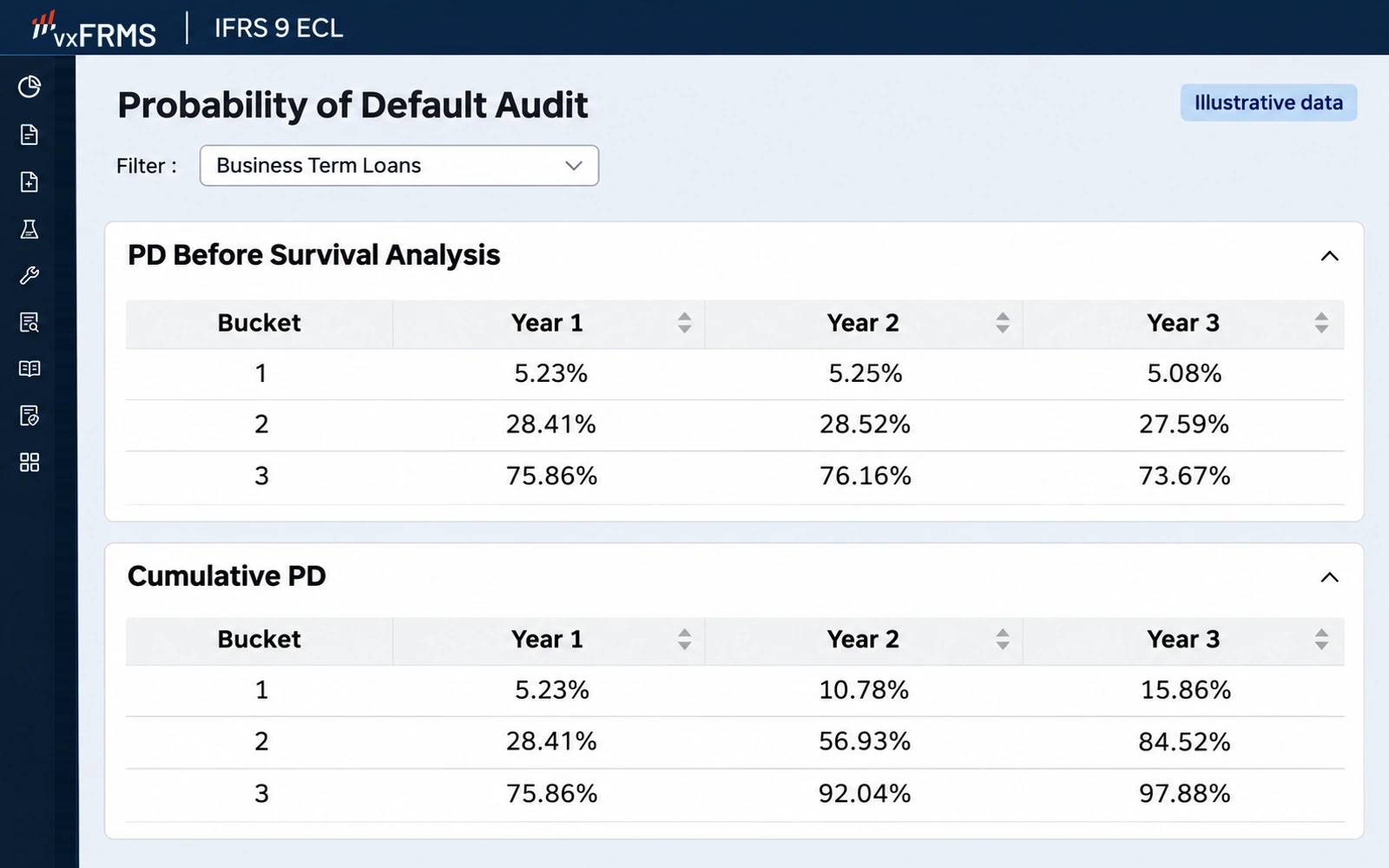
Review pre-survival and cumulative probability of default by risk bucket.
How it works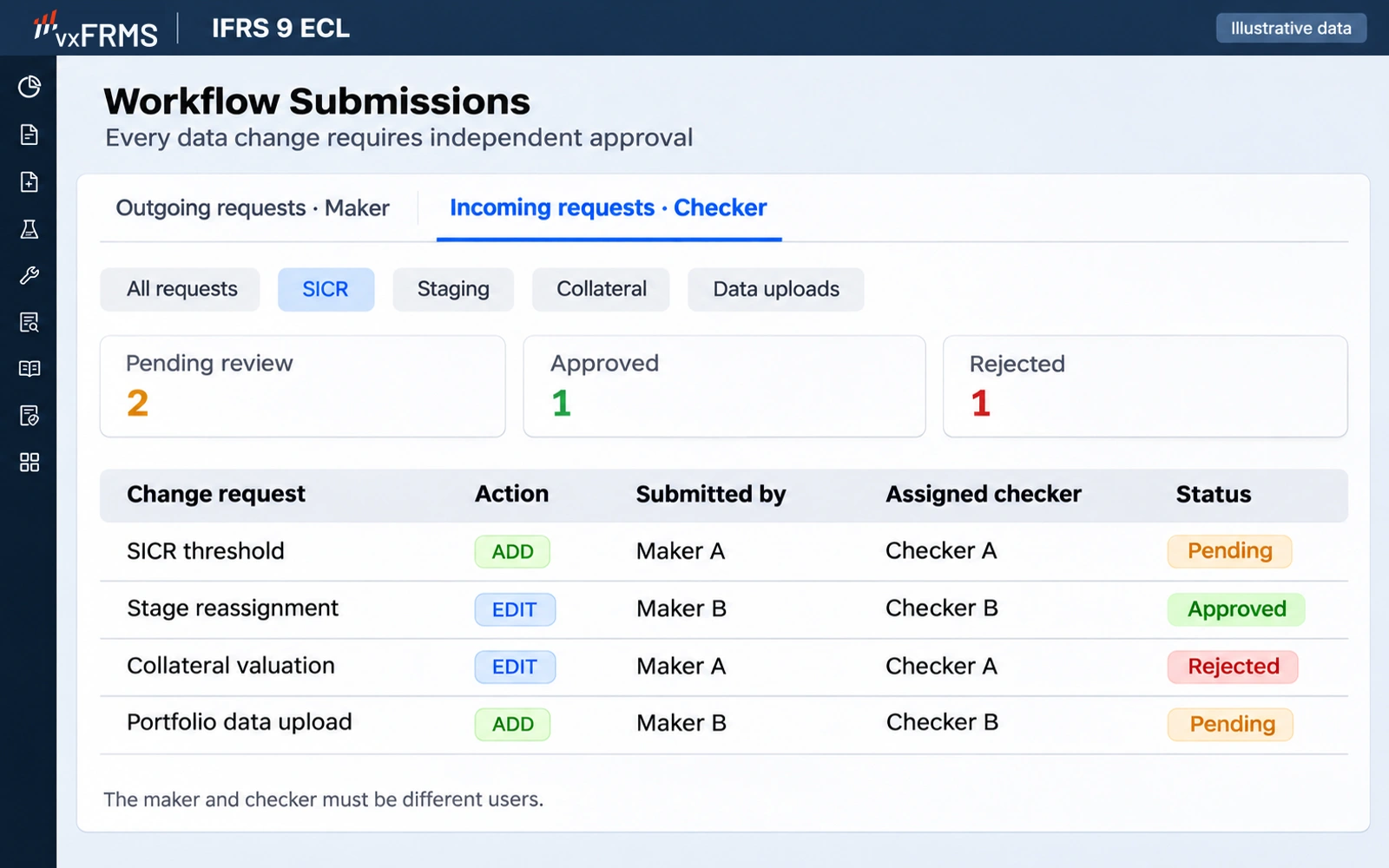
Review ECL data changes through independent maker–checker approval.
How it works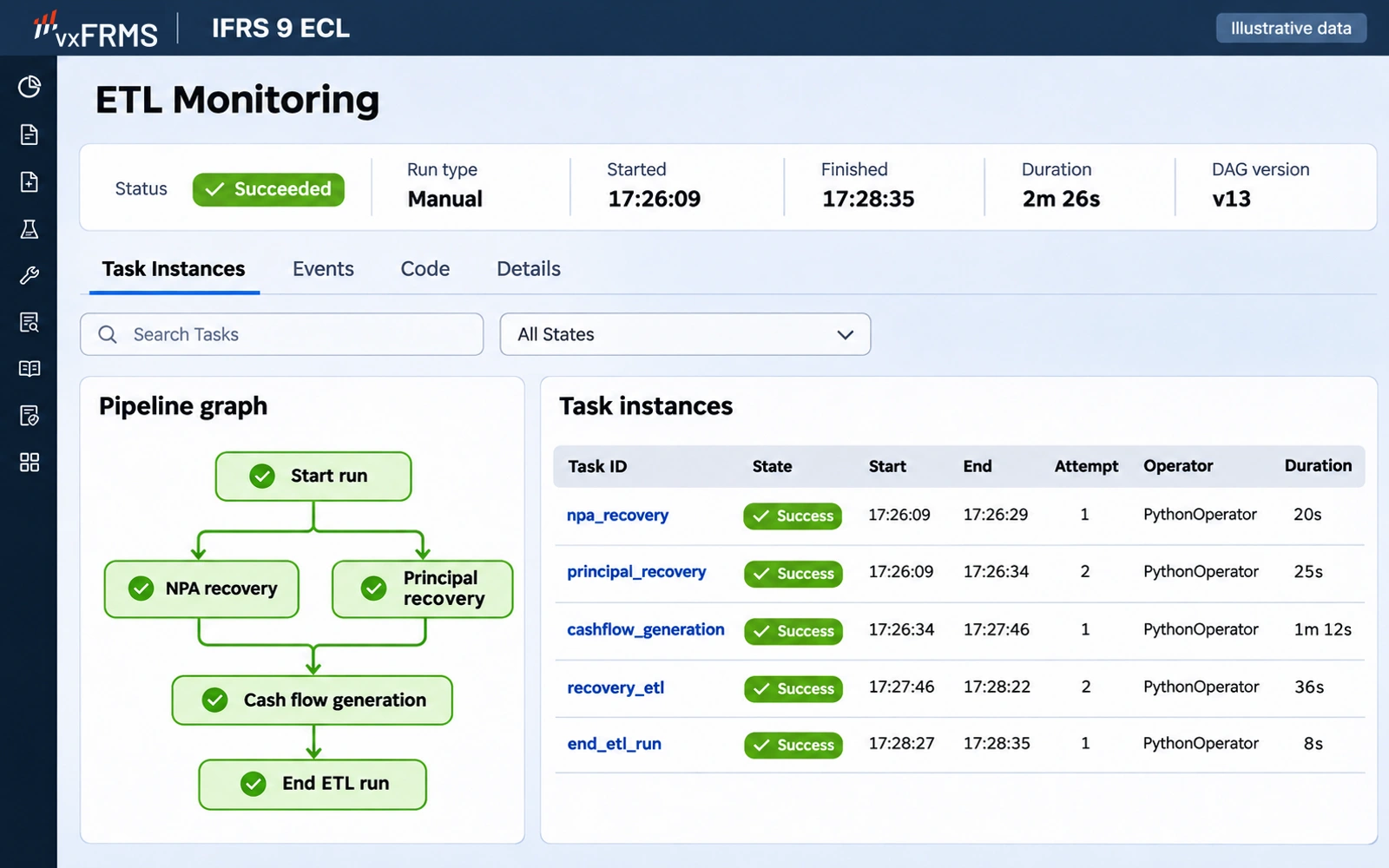
Follow pipeline dependencies, run status, and task execution history.
How it works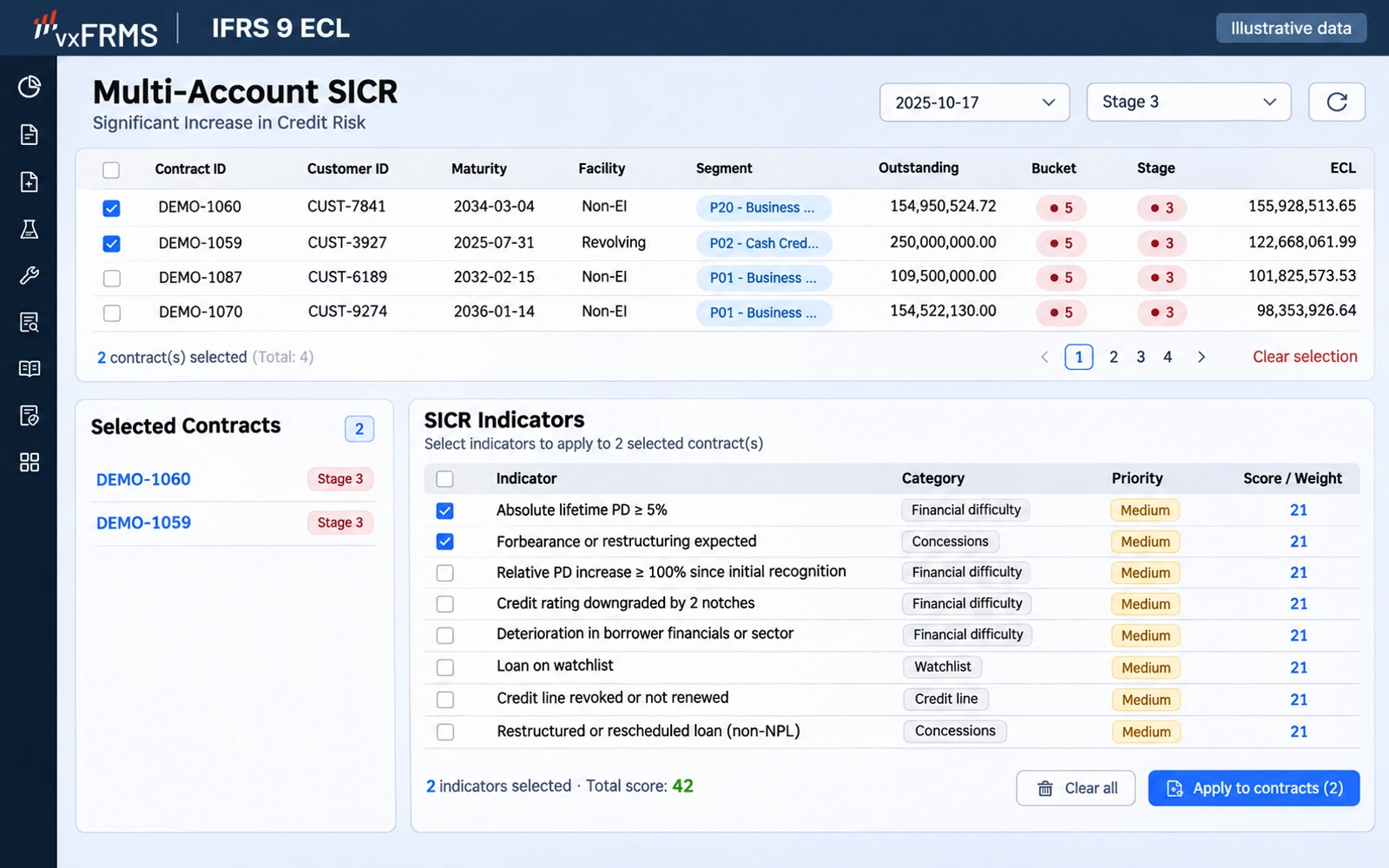
Select SICR indicators and apply them to multiple contracts in one action.
How it worksCALCULATE. CONFIGURE. RECONCILE.
Calculate Effective Interest Rates (EIR) within the ECL system.
Configure model calculations to accommodate each institution’s approved methodology.
See what was calculated, when the calculation ran and who initiated it. Use audit trails and reconciliation to review and reconcile the results.
HOW VXFRMS SUPPORTS YOUR TEAM
Select a step to explore its capabilities and working screen. Select the screenshot to enlarge it.
THE REPORTING CYCLE
Prepare a reconciled dataset for the reporting cycle.
Connect core banking, recovery, collateral and external sources through database interfaces, APIs or secure files. Configure scheduled or on-demand loads, mappings, transformations, validation and duplicate checks. Reconcile at contract and portfolio level, support incremental refreshes, and retain source history and exception logs.
Follow pipeline dependencies and inspect task status, timestamps, attempts, operators, durations and pipeline version.
Illustrative data · Select to enlargeTHE REPORTING CYCLE
Review staging, SICR and individual exposures.
Configure Stage 1, 2 and 3 assignment using delinquency, rating changes, watchlists, restructuring and approved quantitative or qualitative SICR criteria. Apply default, credit impairment, cure and probation rules; retain staging reasons and migration history.
Use the guided SPPI testing interface to assess contractual cash-flow characteristics and access previous tests. Review individual impairment summaries for a selected reporting date.
Select multiple contracts, review indicator categories, priorities and weights, and submit the combined change for approval.
Illustrative data · Select to enlargeTHE REPORTING CYCLE
Apply approved risk parameters, scenarios and measurement rules.
Configure segment-level methods such as roll-rate transition matrices and net flow rates. Maintain through-the-cycle estimates, point-in-time and expert-factor adjustments, approved macroeconomic inputs and versioned parameters.
Use multi-component recovery models or workout methods based on historical cash flows. Configure discounting, collateral haircuts, realization costs and shared collateral allocation. Use vintage recovery triangles for unresolved workouts where appropriate.
Project amortizing balances from repayment schedules. Configure product-specific treatment for revolving credit, undrawn commitments and contingent exposures, with portfolio-level assumptions and period comparisons.
Maintain versioned forecasts, effective dates and probability weights for baseline, upside, downside and additional scenarios. Apply approved portfolio assumptions and compare sensitivities.
Run contract-level 12-month or lifetime ECL using approved staging, parameters and discounting. Retain intermediate results and run logs, then aggregate provisions by segment, portfolio or reporting entity.
Review revolving, non-revolving, non-funded, Stage 3 and credit-card exposure views. Separate model workspaces organize PD, LGD, CCF, EAD and ECL processing.
Filter by portfolio and compare pre-survival and cumulative PD by risk bucket and forecast year.
Illustrative data · Select to enlargeTHE REPORTING CYCLE
Bring adjustments and reporting activities into controlled workflows.
Propose an adjustment with evidence and rationale, compare baseline and adjusted ECL, and route it to an independent checker. Retain original and approved values, affected segments and period/scenario history; reassess overlays each reporting cycle.
Use maker–checker queues for SICR, stage changes, uploads, collateral, individual impairment, disclosures and run freezing. Give administrators a central submission overview and retain the history of proposed changes, approvals and rejections.
Identify the request, submitter, assigned checker and status for each proposed data change.
Illustrative data · Select to enlargeTHE REPORTING CYCLE
Connect portfolio movements to the evidence behind the results.
Manage role-based access and versioned models, rules and parameters. Trace source data through calculations and approvals, including run times and initiators. Review provision movements, stage migration and exposure detail; export reports, IFRS 7 disclosures and agreed regulatory templates.
Compare current and prior-period provisions by portfolio segment and stage, then investigate the drivers of movement.
Illustrative data · Select to enlargeBring advisory and implementation support alongside vxFRMS. Scope the work around your portfolios, data maturity and the capabilities your teams already have.
Assess policies, reporting processes, source systems and historical data. Prioritize gaps, document justified proxies and, where data permits, assess indicative effects on provisions, profitability, capital and financial statements.
Define segmentation, default and SICR criteria, staging, cure rules and overlay governance. Document ownership, approval authorities, committee oversight and operating and audit procedures.
Develop or calibrate PD, LGD, EAD and CCF methodologies. Compare candidate models and design forecasts, scenarios and weights, documenting calibration evidence, data gaps, assumptions and limitations.
Scope validation separately from development. Assess design, data, calibration, stability and implementation through back-testing, sensitivity and stress tests. Track findings through remediation and independent closure.
Translate the approved methodology into source mappings and system configuration. Support pilots, acceptance testing, reconciliation and parallel runs; explain result differences and agree production-readiness criteria.
Support provision reconciliations, disclosures, agreed classification and measurement assessments, regulatory templates and audit queries. Provide role-based training, operating runbooks and scoped go-live support, health checks and recalibration.
Explore the underlying methodology, calculation workflows and reconciliation controls during a private demo.